A baby’s vision goes through many changes in their first year of life. At Tyhee Optometry in Smithers, we love hearing our patients’ stories about how their babies have started to recognize their parents’ faces, focus on colorful toys, or reach out for hugs. Regular eye exams help ensure your baby’s vision continues to develop normally and catch eye health concerns early. But when should babies have their first eye exam?
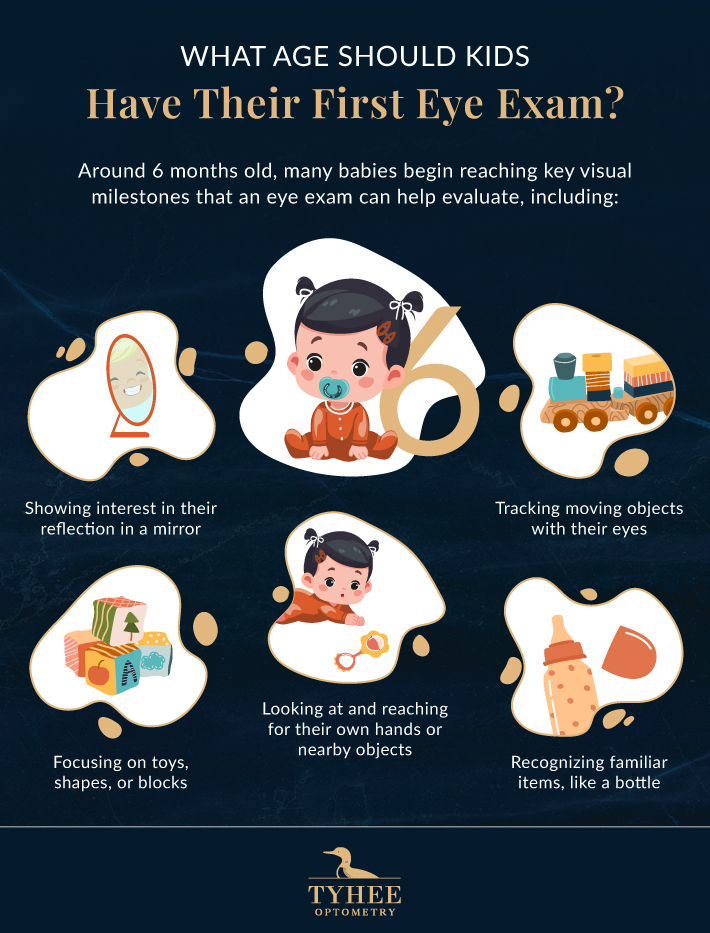
According to guidelines from the Canadian Association of Optometrists, a baby’s first eye exam should be between the ages of 6 and 9 months. This article will explain why this age is recommended, what you can expect at the exam, and how you can support healthy vision development for your baby.
Why do babies need eye exams as early as 6 months old?
Healthy vision is key to your baby’s development. Strong, clear vision is an important building block for crawling, walking, and observing everything from toys to social interactions.
However, babies can be born with several vision problems that might interrupt these key developmental milestones. Early detection of these issues can significantly help your baby’s development and quality of life. Common conditions that can be detected early include:
- Amblyopia (or “Lazy Eye”): According to B.C. Children’s Hospital, amblyopia affects about 100,000 Canadian children. It is a condition where the vision in one eye is weaker than the other. If one eye isn’t seeing clearly, the brain will learn to ignore signals from that eye, and normal binocular vision will fail to develop.
- Strabismus (“Crossed Eyes”): This is an eye muscle condition where the eyes do not align correctly, making it difficult to use both eyes together to focus. According to the Canadian Association of Optometrists, 1 in 20 children have some form of strabismus. Since the eyes are not aligned, it causes double vision, leading the brain to suppress signals from one eye.
Bringing your baby in for an eye exam at 6–9 months old—even if you don’t see any obvious issues—helps your optometrist establish a baseline for their eye alignment and vision. This baseline, along with yearly follow-up appointments, ensures your baby’s vision is developing on track so they can successfully reach for their favorite people and explore the world.
What will my baby’s first eye exam look like?
An infant eye exam at Tyhee Optometry uses child-friendly techniques to see how your baby uses their eyes to focus on and follow objects. These tests use colorful shapes, lights, and patterns, so they are engaging and not scary. In fact, parents and babies often have fun watching the lights!
Unlike adult exams, only objective measures and tests are used. For instance, the optometrist will observe how different lights reflect off your baby’s eyes to determine things like nearsightedness, farsightedness, and eye alignment issues.
How can I help support my baby’s vision?
Beyond regular eye exams, the Canadian Association of Optometrists recommends specific activities to stimulate vision in babies:
- Games: Play peek-a-boo and use stacking cups or ring toys.
- Visual Aids: Read board books with bright pictures.
- High Contrast: Use everyday objects with bright colors and high contrast, such as black and white or primary colors.
Book Your Baby’s First Eye Exam in Smithers
Booking your baby for their first eye exam at 6–9 months old is an easy and effective way to ensure their vision is developing well. No matter the age of your child, the team at Tyhee Optometry is here to help keep their eyes healthy in a fun, engaging, and gentle environment.
You can book your baby’s eye exam today at (250) 847-2020 or online.