
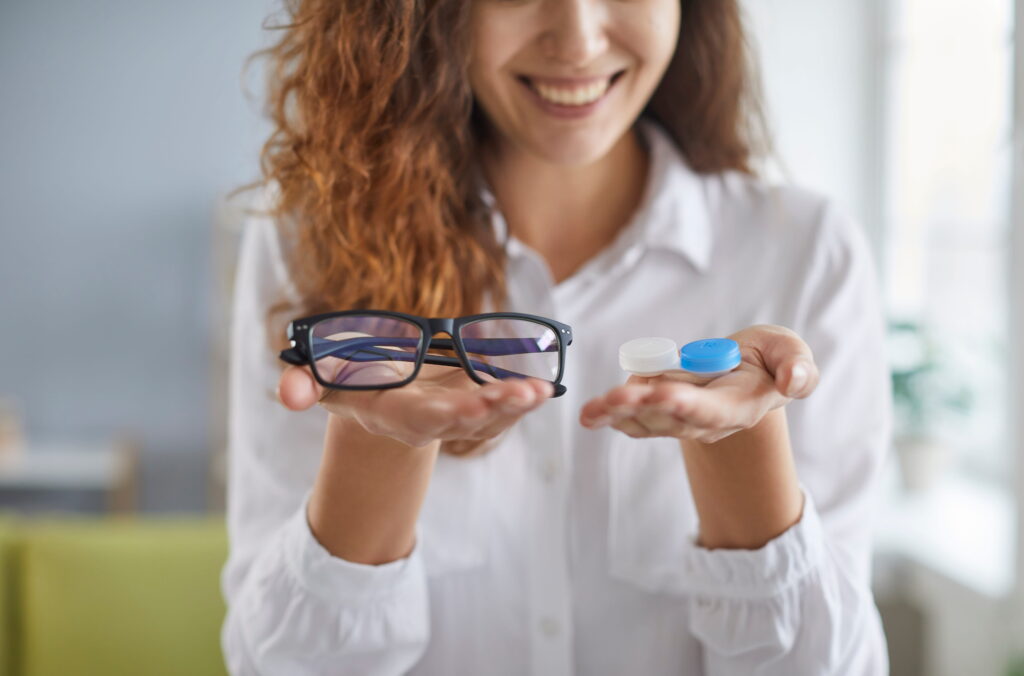
It’s official! After your annual comprehensive eye exam, your optometrist delivered the news: you need corrective lenses. Now, you face a choice that affects your daily routine, your eye care, and even your sense of style – do you want to wear glasses or contact lenses?
Both types of corrective eyewear are carefully designed to help you see the world clearly and comfortably. At Tyhee Optometry, we stock high-quality, comfort-first contact lenses from Alcon and work with HOYA Vision Care to provide ultra-clear optical lenses for glasses.
That way, there is no wrong answer! Neither is better than the other, but both optical lenses and contact lenses have pros and cons for convenience, ease of use and eye health.
This article will help explain what the major differences are between glasses and contact lenses in your daily routine, what you can expect when purchasing them, as well as eye health and lifestyle factors you might consider to help you make your choice.
What’s a daily routine like with glasses versus contact lenses?
Both of these lenses are made to correct refractive errors – also known as near- and far-sightedness, which develop when light entering the eye doesn’t land properly on the retina. There is one major difference between optical lenses and contact lenses though: optical lenses sit in front of your eye to help guide the light to your retina, but contact lenses sit on your eye (hence the name “contact” lenses!)
Therefore, one benefit of glasses is how simple they are to use on a daily basis. In the morning, you put them on and have clear, consistent vision until you take them off at the end of the day.
While glasses can be cleaned as needed, it is important to clean them regularly with a lens-specific cleaner and lint-free cloth to prevent scratches, skin irritation, and to keep your vision clear.
Contact lenses, on the other hand, require more daily care and strict hygiene. Before putting them on in the morning or taking them off at night, The Canadian Association of Optometrists recommends washing, rinsing, and drying your hands thoroughly so you do not transfer bacteria, dust, or other particles onto your eye. If you choose to wear monthly contacts, there are additional disinfecting steps to avoid eye infections and other problems, which will be prescribed by your optometrist.
Over time, these steps become second-nature, but contact lenses do require more work to learn to use than glasses.
However, for many people, contact lenses feel worth the extra work. Contact lenses can’t slide down your nose while you’re exercising or playing sports, won’t fog up when coming in and out of the cold, and means you don’t have to wear frames!
What is the process for buying glasses versus contact lenses?
Buying glasses and contact lenses both require consultations to find what fits and feels most comfortable.
Buying glasses at Tyhee Optometry is as much about style as it is comfort! You will be able to try on any of our 300+ frames in all kinds of colours, shapes, and materials with the help of an optometric assistant. These staff members are trained to help you find the frame size and shape that fits on your nose and ears to reduce slippage and discomfort. Once you select your frame, these staff members will be able to advise you on the best type of lenses to suit your needs.
Contact lenses require a different form of consultation, especially if it is your first time using them. First-time users will receive one-on-one guidance from a trained assistant on how to safely insert and remove contact lenses. Once you have successfully inserted and removed the lenses three times, our optometrist will conduct a thorough examination to ensure the lens is fitted comfortably to your eye.
What are some lifestyle and health factors I should consider when choosing between glasses versus contact lenses?
Certain lifestyle and health factors can be important when choosing glasses versus contact lenses:
- Workplace safety: according to the Canadian Centre for Occupational Health and Safety, contact lenses cannot be worn for certain jobs due to potential for contamination or irritation by airborne particles or chemical substances. Check with your workplace safety supervisor to see if contacts are suitable for you.
- Activity level: If you are someone who is constantly on the move, or works an extremely active job, contact lenses may be the best choice for clear, non-distracting vision
- Executive function: If you are someone who struggles with executive function, the daily routine of contact lenses may be difficult to upkeep which can compromise eye health. Glasses may be the safest choice, but alarms, calendars, and other scheduling devices can help make it easier to remember to take out and clean your contact lenses!
- Unusual prescriptions or eye health concerns: If you have severe myopia (near-sightedness), dry eye disease, or blepharitis (eye inflammation), glasses may be the safest and most comfortable choice.
So…should I choose glasses or contact lenses?
Thanks to high quality technology, most people can wear either (or both!) contact lenses or glasses. It is mostly up to personal preference – but here is a list of a few things to take into account that might help you make your choice:
If you…
- Can maintain hygienic, clean hands
- Feel comfortable maintaining a daily disinfecting routine
- Are okay with touching your eyes
- Are free from eye health conditions like allergies, blepharitis, or are not prone to eye infections
- Frequently wear non-prescription sunglasses, safety glasses, or ski (and other sport) goggles
- Like the idea of lenses that don’t fog up, slip down your nose, or get in the way while doing your active hobbies
- Prefer how you look without frames
- Find frames cause sensory discomfort
Then contact lenses may be the best choice for you
If you…
- Like the efficient ease of popping on a frame and going about your day
- Enjoy photochromic (colour-changing) lenses that go dark outside and stay light inside
- Have eye health conditions like allergies, blepharitis, or chronic eye infections
- Don’t want to touch your eyes
- Like having some protection against wind, dust, and debris
- Like the style and look of wearing frames
Then glasses may be the best choice for you.
Keep in mind that even as a daily contact wearer, it is a good idea to have a backup pair of glasses. If you experience an eye infection, an allergic reaction, or simply lose your contact lenses, you’ll need a pair of glasses to wear instead for clear vision!
At Tyhee Optometry, we have stylish, high-quality glasses starting as low as $190, so you’ll never be without clear, comfortable vision.
Book Your Contact Lens Assessment or Frame Consultation in Smithers
Now that you have your first prescription, you can do the fun part: choosing fashionable frames or learning to use your contacts for the first time!
You may walk-in to our frame gallery at any time during operating hours to get assistance from our trained optometric assistants.
Contact lens assessments are a one-on-one appointment and require advanced booking. You can book yours today at (250) 847-2020 or online.